
Quick Answer: Choosing a LiFePO4 battery comes down to five checks, in order: match the nominal voltage and communication protocol to your inverter, size the bank in kWh from daily consumption and backup time, confirm the BMS current rating covers your peak load, pick a form factor the site actually allows, and verify the certifications behind the numbers. Voltage is the only one that cannot be corrected later — a 51.2V pack will never run on a 24V inverter — so it goes first.
Match the Voltage to Your Inverter First
Every LiFePO4 battery is a series string of 3.2V cells, which is why nominal voltages come in fixed steps: 51.2V for 48V-class hybrid inverters, 25.6V for 24V systems, and 12.8V as the drop-in replacement platform for 12V lead-acid batteries. The battery has to sit inside the DC input window your inverter accepts. Get this wrong and you don’t have a configuration problem — you have a returned shipment.
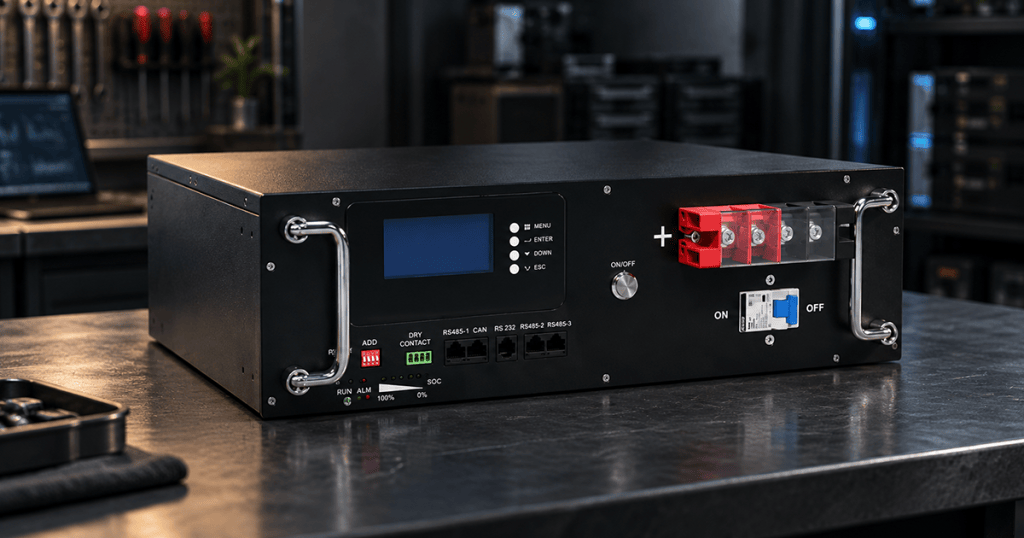
Voltage is only half of inverter compatibility. The other half is communication. A battery that talks to the inverter over CAN or RS485 lets the inverter read state of charge, health status, and alarms directly from the BMS instead of estimating them from terminal voltage — which is what makes automated charge control and clean low-battery shutdowns possible. Techfine’s LB, LC, and LR batteries carry RS232, RS485, and CAN ports as standard, with a user-selectable protocol covering Pylon, Growatt, Voltronic Power, Pengcheng, Schneider, and SRNE. One SKU can serve several inverter brands, and a protocol change is a settings operation, not a factory visit.
For standard 48V home or small-commercial storage, the LC series wall-mounted battery and the LB series cover 51.2V and 25.6V platforms; integrators building into racks start with the LR series.
Size the Bank in kWh, Not Just Amp-Hours
Amp-hour ratings only compare batteries at the same voltage. The number that decides your backup time is battery capacity in kilowatt-hours, and it comes from two inputs: how many kWh the site consumes per day, and how many days of autonomy you want when the sun or the grid is out.
The arithmetic is short. A home using 10 kWh per day that wants one full day of autonomy needs roughly 10 kWh of usable storage. Because Techfine’s LiFePO4 modules specify a depth of discharge of 95% or better, usable capacity sits close to the nameplate figure — two 51.2V 100Ah modules at 5.12 kWh each (10.24 kWh combined) or a single 11.78 kWh 230Ah module both cover that load with margin. A lead-acid bank sized the same way needs roughly double the nameplate, since lead-acid is typically cycled to around half its rated capacity.
Building blocks then scale by parallel connection. The LB and LC series run 51.2V modules from 5.12 up to 16.08 kWh per unit, and the line supports up to 15 modules in parallel — over 240 kWh from 16 kWh building blocks, enough to carry a small commercial site through an overnight outage. When a project grows later, you add modules; you don’t scrap the first bank.
Check the BMS Current Rating Against Your Peak Load
Battery modules carry a battery management system rated for a maximum continuous discharge current, and this rating — not the capacity — decides whether the bank can feed your inverter at full output. The relevant physics is one multiplication: power equals voltage times current.
Techfine’s modules come in two BMS classes, 100A and 200A continuous discharge, which at 51.2V translates to 5,120W and 10,240W of maximum power output per module. A 10 kW inverter running flat out on a 51.2V bus draws about 195A, so it belongs on the 200A class. A 5 kW inverter draws roughly 98A — inside the 100A rating but with no headroom for surge loads, so most installers move up a class or share the load across two modules. The LR rack-mount series offers both classes (5.12 kWh at 100A, 11.78 kWh at 200A), which lets rack builds match current rating to inverter size module by module.
Rack, Wall, or Wheel: Match the Form Factor to the Site
The same kilowatt-hours arrive in four shapes, and the installation space usually picks the right one before the datasheet does.
Rack-mount. The LR series slides into the equipment racks found in telecom shelters, server rooms, and integrator enclosures — a 5.12 kWh module is 133 mm high and 45 kg; the 11.78 kWh unit is 223 mm and 100 kg. Where rack space runs short, the smaller module also mounts on a wall.
Wall-mount. The LC and LB series hang on garage and plant-room walls as metal cabinets — an LC 51.2V 100Ah unit is 49 kg, manageable for a two-person lift, while the LB 25.6V 100Ah is 34 kg. LC cabinets add a built-in circuit breaker as a physical disconnect on top of the BMS protection.
Wheeled floor units. The high-capacity end of the LB and LC lines — the 14.34 and 16.08 kWh models at 117–120 kg — ships on wheels instead of brackets, for sites that want stored energy without committed wall structural work.
12V drop-in. The LP series replaces 12V lead-acid batteries directly: 12.8V nominal, 0.64–4.02 kWh, 8–26.5 kg, an ABS shell rated IP64 rather than the IP21 of the indoor cabinets, and an optional English color display on the -D models for status at a glance.
One environmental note that bites projects in hot climates: the LB, LC, and LR cabinets are rated IP21 for indoor use. If the battery lives outdoors or in a dusty plant area, plan a ventilated indoor room — only the LP series carries the higher IP rating.
Read Cycle Life and DoD Claims Before You Compare Them
“6,000 cycles” means nothing until you know the test behind it. Cycle-life figures are generated under standard charge and discharge at 25°C, and the number changes with depth of discharge, charge rate, and temperature — which is why a like-for-like comparison has to pin those conditions down before it means anything.
Across Techfine’s line the published ratings run from 5,000 to 8,000 cycles by model, with most modules at 6,000 or better under standard charge/discharge at 25°C. End-of-life is commonly defined as the point where a battery retains about 80% of its rated capacity — worth confirming the definition whenever a supplier quotes a cycle count, since the same number can describe very different batteries.
Depth of discharge works in lithium’s favor here. LiFePO4 chemistry tolerates deep cycling that damages lead-acid, and the ≥95% DoD rating means almost the whole nameplate is usable daily. Over a 15-year solar-storage life, the replacement math usually lands where the LP series positions it against the lead-acid batteries it replaces: 8–10× the cycle life.
Certifications Worth Requiring From Any Supplier
Three documents separate a bankable battery from a bargain. UN 38.3 testing is the transport-safety baseline — without it, lithium batteries legally cannot ship on most freight routes. IEC 62619 is the international safety standard for industrial lithium cells and batteries, covering behavior in both normal operation and fault conditions. CE marking rounds out the set for European projects, and the EU Battery Regulation is phasing in sustainability and due-diligence duties that EU-bound shipments will increasingly have to answer for.
Ask two follow-up questions when you review a spec sheet. First, is the certification per model or per series? A test report covering a different capacity or voltage variant than the unit you’re buying is a gap. Second — specific to lithium transport — sea and road transport appraisals are renewed annually, so ask for the current documents, not last year’s. Every Techfine battery model ships UN 38.3 tested, with IEC 62619 and CE certification per model, and current transport documentation available on request.
Which LiFePO4 Battery Should You Choose?
| Your project | Start with | Why |
|---|---|---|
| 48V home or small-commercial ESS, wall install | LC series | 51.2V/25.6V, 2.56–16.08 kWh wall cabinets, breaker protection |
| Highest capacity per module, mobile install | LB series | up to 16.08 kWh per module, wheeled high-capacity cabinets |
| Telecom, server-room, or integrator racks | LR series | 51.2V rack modules at 5.12/11.78 kWh, wall-mount compatible |
| Replacing 12V lead-acid batteries | LP series | 12.8V drop-in, 0.64–4.02 kWh, IP64 ABS shell |
All four series and their datasheets are collected in the storage battery section.
Frequently Asked Questions
Can I mix 25.6V and 51.2V batteries in one system?
No. Modules connected in parallel must share the same nominal voltage and model family, and the bank voltage has to match the inverter’s DC input window. A 24V system scales by adding 25.6V modules — it doesn’t bridge to 51.2V without changing the inverter too.
How many modules can run in parallel?
The LB, LC, and LR series support 1–15 modules in parallel — fifteen 16.08 kWh units put roughly 240 kWh behind one system. The LP series is different by design: standalone 12.8V drop-in batteries, not parallel building blocks.
Can an LP battery replace a 12V lead-acid battery directly?
In most 12V applications, yes — same nominal platform and M8 terminals, in a drop-in ABS case. The one thing to check is the charger: LiFePO4 wants a lithium charge profile (14.4V recommended, 14.6V maximum for this 4-cell platform), so a charger with a fixed lead-acid equalization stage should be switched to a lithium mode. The -D models add an English color display for voltage, current, and status without a separate monitor.
Do Techfine batteries work with Growatt or Pylon inverters?
Yes. The LB, LC, and LR models communicate over RS232, RS485, and CAN with a user-selectable protocol covering Pylon, Growatt, Voltronic Power, Pengcheng, Schneider, and SRNE — the BMS and inverter exchange state of charge, health, and alarm data rather than guessing. The LP series has no inverter protocol integration; it is a standalone 12.8V battery.
Choosing a LiFePO4 battery that survives commissioning and the decade after it means buying against the inverter, the load profile, and the room it installs in — not against a single headline number. If a project needs a configuration outside the combinations above, contact Techfine with the inverter model and daily consumption, and the engineering team will size the bank for you.