
A battery and an inverter can work together in silence — wires carry power, the inverter watches terminal voltage, and everyone hopes for the best. That’s how systems ran for decades, and it’s still how cheap systems run today. The alternative is a conversation: the battery’s BMS tells the inverter what it actually holds, how healthy it is, and where its limits are, and the inverter acts on facts instead of guesses.
That conversation is inverter communication, and it runs over CAN and RS485 — and whether a battery speaks the right protocol decides more about system behavior than any spec on the front page of the datasheet. This guide explains what travels on the wire, what breaks without it, how the two buses divide the work, and what “user-selectable protocol” means when you’re the one holding the order form.
Quick Answer: Why CAN and RS485 Matter
CAN and RS485 are the two wired buses that connect a LiFePO4 battery’s BMS to an inverter or monitoring system. Over them, the inverter reads state of charge, state of health, alarms, and current limits straight from the BMS — instead of estimating them from terminal voltage. That’s what makes automated charge control, clean low-battery shutdowns, and remote monitoring possible.
The LB, LC, and LR batteries carry RS232, RS485, and CAN ports as standard, with a user-selectable protocol covering Pylon, Growatt, Voltronic Power, Pengcheng, Schneider, and SRNE. Translation for the order form: one battery SKU can serve several inverter brands, and changing between them is a settings operation, not a factory visit.
What Actually Travels on the Wire
The BMS inside a modern LiFePO4 pack is continuously measuring things the terminals can’t show. On our sheets, that telemetry includes voltage accurate to within 20 mV, current within 2% of full scale, and battery temperature within 2°C — plus the derived values that matter more to the system: state of charge (how full), state of health (how worn), and active alarms (what’s wrong right now). (For how each of these numbers connects to the rest of a datasheet, the battery specs guide has the arithmetic.)
With a protocol connection, the inverter consumes that telemetry directly:
- Charge control that respects the battery. The inverter knows the real state of charge and the BMS’s charge-current preference, instead of inferring “probably full” from a voltage plateau.
- Clean low-battery shutdowns. When the bank approaches its floor, the inverter can stage a proper shutdown — saving work, logging the event, and protecting the cells from deep discharge.
- Alarms that reach someone. Over-temperature, over-current, and cell-fault warnings arrive as data, not as a dead system discovered during the next outage.
- Remote visibility. The same ports feed monitoring platforms, so a fleet of sites can be watched without visiting them.
None of this is exotic — it’s the difference between a system that shuts down gracefully and one that simply stops.
What Happens Without It
When a battery and inverter don’t share a protocol, the inverter falls back on terminal voltage — a number that barely moves across most of a LiFePO4 discharge curve. The consequences are exactly what you’d expect from guessing:
Early shutdowns, because the inverter plays safe against a flat voltage curve it can’t read. Late shutdowns, because sometimes it doesn’t play safe and the BMS has to cut the load itself — abruptly. No health visibility, so a gradually failing bank looks identical to a healthy one until the day it doesn’t. And charge current that follows the inverter’s default rather than the battery’s preference, quietly trading lifespan for simplicity.
For a lead-acid system this was tolerable — voltage curves are steep and forgiving. For lithium, whose curve is flat and whose limits are enforced by a BMS, voltage-guessing leaves most of the chemistry’s value on the table. If you take one thing from this article: protocol compatibility is a battery spec, as real as voltage or cycle life.
CAN vs. RS485: Two Buses, Two Jobs
Both names describe serial buses built for industrial environments, and the batteries carry both because they’re good at different jobs.
CAN (Controller Area Network, born in the automotive world) is the conversation bus. It’s message-based, robust in electrically noisy environments, and it’s the language most hybrid inverters expect a battery to speak. When a protocol list says “Pylon” or “Growatt,” that’s CAN carrying each brand’s dialect: same wires, same physical standard, different vocabulary.
RS485 is the workhorse bus for monitoring and diagnostics — multi-drop wiring over long cable runs, the classic choice for connecting batteries to dataloggers, host-computer monitoring software, and building management systems. Our LB sheets also list RS485 for parallel communication between modules, keeping a multi-module bank coordinated.
RS232, the third port, is the service port: point-to-point, for commissioning tools and factory diagnostics. You’ll touch it rarely, but when a bank misbehaves, it’s how the conversation gets detailed.
The division of labor is clean: CAN talks to the inverter, RS485 talks to everything else, RS232 talks to the engineer.
“User-Selectable Protocol” in Practice
Here’s where the spec sheet meets the order form. “Protocols” aren’t hardware variants — the LB, LC, and LR batteries carry the same RS232/RS485/CAN ports regardless, and the active inverter protocol is selected in settings from a list covering Pylon, Growatt, Voltronic Power, Pengcheng, Schneider, and SRNE.
For an integrator, that means the battery decision survives the inverter decision: quote Pylon today, swap to Schneider when the customer changes their mind, and the same LR rack-mount modules ship. For a distributor, it means inventory rationalization: one SKU serves several inverter ecosystems instead of a part number per brand. And for after-sales, a protocol mismatch discovered at commissioning is a settings change on site — not a return shipment, not a factory visit. The wider checklist — voltage window first, protocol second, sizing third — is in our LiFePO4 selection guide.
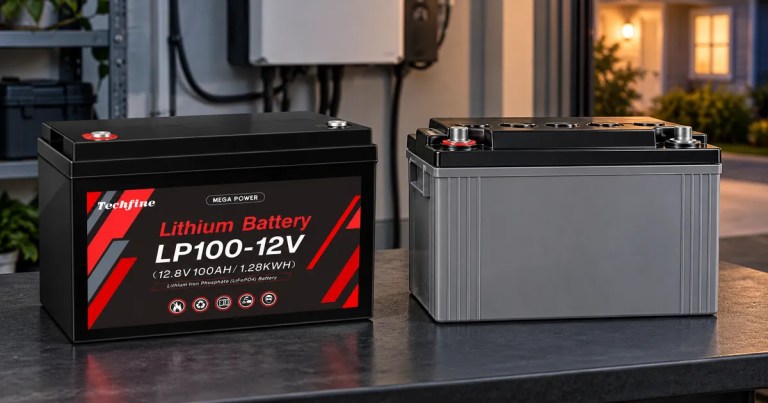
The one line to check carefully: the protocol list is per family. The LB/LC/LR modules speak the full list; the LP 12.8V series is deliberately standalone, with no inverter protocol integration at all — it’s a drop-in replacement battery, not a system component.
Commissioning: Getting the Conversation Started
A protocol connection is simple when it’s right and maddening when it’s half-right. The checklist that avoids the maddening kind:
- Match protocol to inverter model, not just brand. Confirm the inverter’s actual model (and firmware, where relevant) is covered by the battery’s protocol list — brands run multiple generations in parallel.
- Select and verify. Set the battery to the inverter’s protocol, power the bus, and confirm the inverter displays a live state of charge — a number that moves with load is the simplest pass/fail test there is.
- Test the alarm path. Confirm at least one alarm condition (a pull of the service disconnect is usually enough) reaches the inverter or monitoring screen before you sign off.
- Label the bus. Future technicians should not have to reverse-engineer which cable is CAN and which is RS485.
None of this takes long; all of it takes longer than not doing it — which is the argument for doing it at commissioning rather than at the first fault.
When You Don’t Need It
Honesty section: not every battery purchase needs a protocol conversation. A standalone 12V battery keeping a router alive, a drop-in replacement for a lead-acid starter bank, a portable power setup with no inverter ecosystem — the LP series serves exactly these with no communication ports at all, and that’s the correct design, not a cost-cut.
The dividing line is system behavior: if an inverter orchestrates the battery, the battery must speak the inverter’s language. If nothing orchestrates it, silence is fine. Buyers planning to “add an inverter later” should buy the talking battery now — communication is hardware at purchase, not a firmware upgrade afterward.
FAQ: Battery-Inverter Communication
What does CAN mean on a battery?
CAN is the message-based bus a battery’s BMS uses to talk to a hybrid inverter. Over CAN, the inverter reads live state of charge, health status, alarms, and current limits from the battery, which enables automated charge control and staged low-battery shutdowns instead of voltage guessing.
What is RS485 used for on a LiFePO4 battery?
RS485 is the multi-drop monitoring bus: it connects the battery to dataloggers, host-computer monitoring software, and building management systems over long cable runs, and on our LB modules it also coordinates communication between parallel batteries in one bank.
Does my inverter brand need to be on the battery’s protocol list?
Yes — protocol compatibility is what makes the conversation work. The LB, LC, and LR batteries cover Pylon, Growatt, Voltronic Power, Pengcheng, Schneider, and SRNE via a user-selectable setting. If your inverter isn’t listed, ask before ordering: compatibility lists grow, and the answer is a message, not a guess.
Can communication be added to a battery later?
No — the ports and protocol support are hardware decisions made at purchase. A battery bought without CAN/RS485 can’t gain them by firmware. If there’s any chance an inverter will orchestrate the bank later, buy the communicating version now; the LP series is the deliberate exception for standalone use.
Do parallel batteries need communication between each other?
Yes. Modules sharing a bus coordinate through their own communication — on our LB modules, RS485 handles the parallel coordination so the bank presents one coherent battery to the inverter instead of several disagreeing ones.
The electrical specs tell you what a battery can do; the communication tells you what the system can do with it. Charge control that respects the cells, shutdowns that save work, alarms that reach a screen, fleets that don’t need visiting — all of it rides on two modest buses and a compatible protocol list. When you’re ready to match batteries to an inverter line, browse the LiFePO4 storage battery range — and for the awkward pairings, contact Techfine with the inverter model and we’ll confirm compatibility before you order.